The conceptions of transitional justice based on the 20th-century transitions are mainly influenced by interactional conceptions of justice and reconciliation and by an understanding of transitional justice as a type of post-conflict justice. They are informed by the particular injustices and ideals involved in past transitions, such as the post-apartheid transition in South Africa and the democratic transition in Argentina.
Many ongoing and future transitions deal with other types of injustices, circumstances, and ideals. Some of these transitions aim to overcome structural injustices with or without historical roots. The #MeToo, #YoSiTeCreo, and BLM movements are examples of this type of transition. Other transitions aim for structural transformations to avoid future harm or implement a novel technology. The transition to a neutral carbon society and AI development illustrates this second kind of transition.
This workshop aims to address the following questions: What are the moral and political concerns, challenges, and dilemmas addressed by transitional justice theories and experiences that are now reproduced in new transitions like the climate transition? What can we learn from transitional justice theory and experiences to deal with new transitions, such as the transition to a neutral carbon society?
This workshop is part of a series of activities organized by the FWF project “A Political Conception of Transitional Justice” (https://transitional-justice.uni-graz.at/en/the-project/ ). The workshop will include a series of lectures with attendant commentaries.
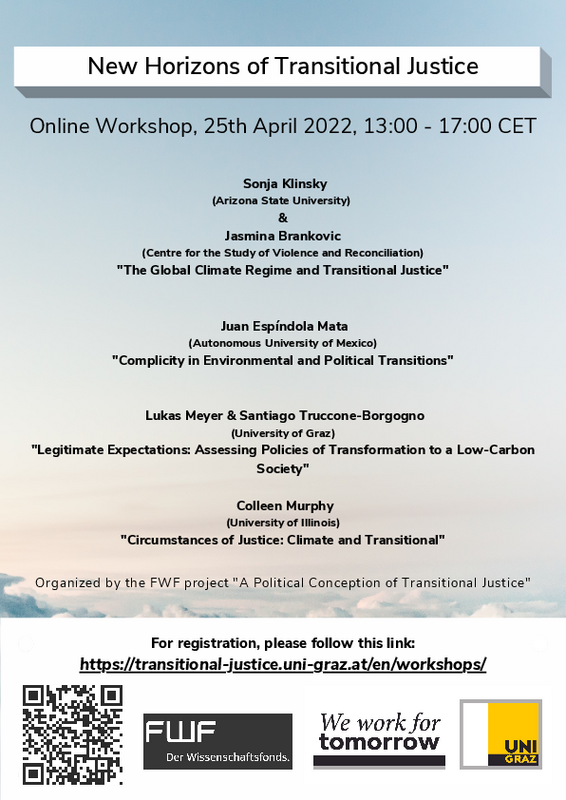
Programme (April 25th)
13:00-13:50 (CET) Lukas Meyer & Santiago Truccone-Borgogno (University of Graz)
“Legitimate Expectations: Assessing Policies of Transformation to a Low-Carbon Society”
13:50-14:00 (CET) Break
14:00-14:50 (CET) Colleen Murphy (University of Illinois)
“Circumstances of Justice: Climate and Transitional”
14:50-15:00 (CET) Break
15:00-15:50 (CET) Juan Espíndola Mata (Autonomous University of Mexico)
“Complicity in Environmental and Political Transitions”
15:50-16:00 (CET) Break
16:00-16:50 (CET) Sonja Klinsky (Arizona State University) & Jasmina Brankovic (Centre for the Study of Violence and Reconciliation)
"The Global Climate Regime and Transitional Justice"
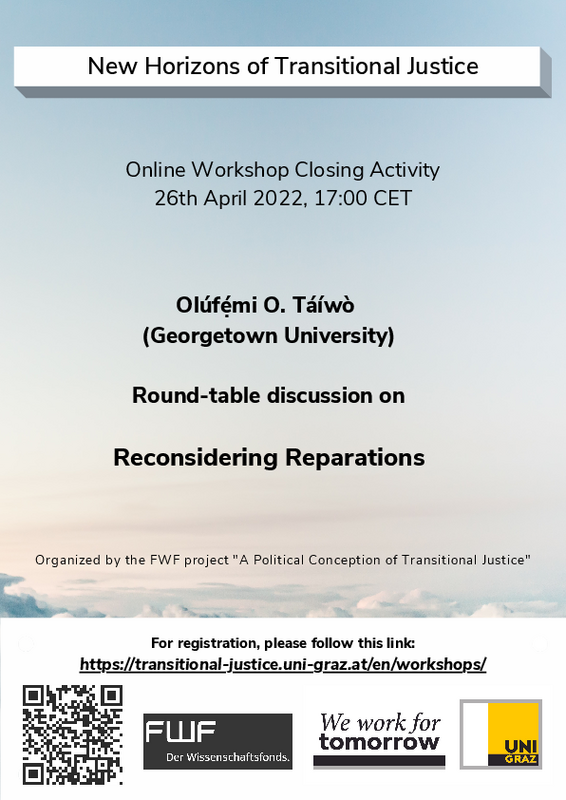
Programme (April 26th)
Online Workshop closing activity
17:00 (CET) Olúfẹ́mi O. Táíwò (Georgetown University)
Round-table discussion on
Reconsidering Reparations
>> Registration
The Online workshop is organized by the FWF project "A Political Conception of Transitional Justice".